Investing and trading—whether in stocks, commodities, or cryptocurrencies—can be thrilling and profitable, but it’s also laden with risks.
One of the cardinal rules of financial markets is risk management, with stop losses at the heart of this discipline.
However, while stop losses are designed to protect traders from major losses, psychological factors often keep them holding on to losing positions, resulting in substantial setbacks.
In this post, we’ll explore the importance of using stop losses, delve into the psychology of loss, discuss common mistakes traders make, and offer practical strategies to help develop a disciplined approach to cutting losses early.
What is a Stop Loss?
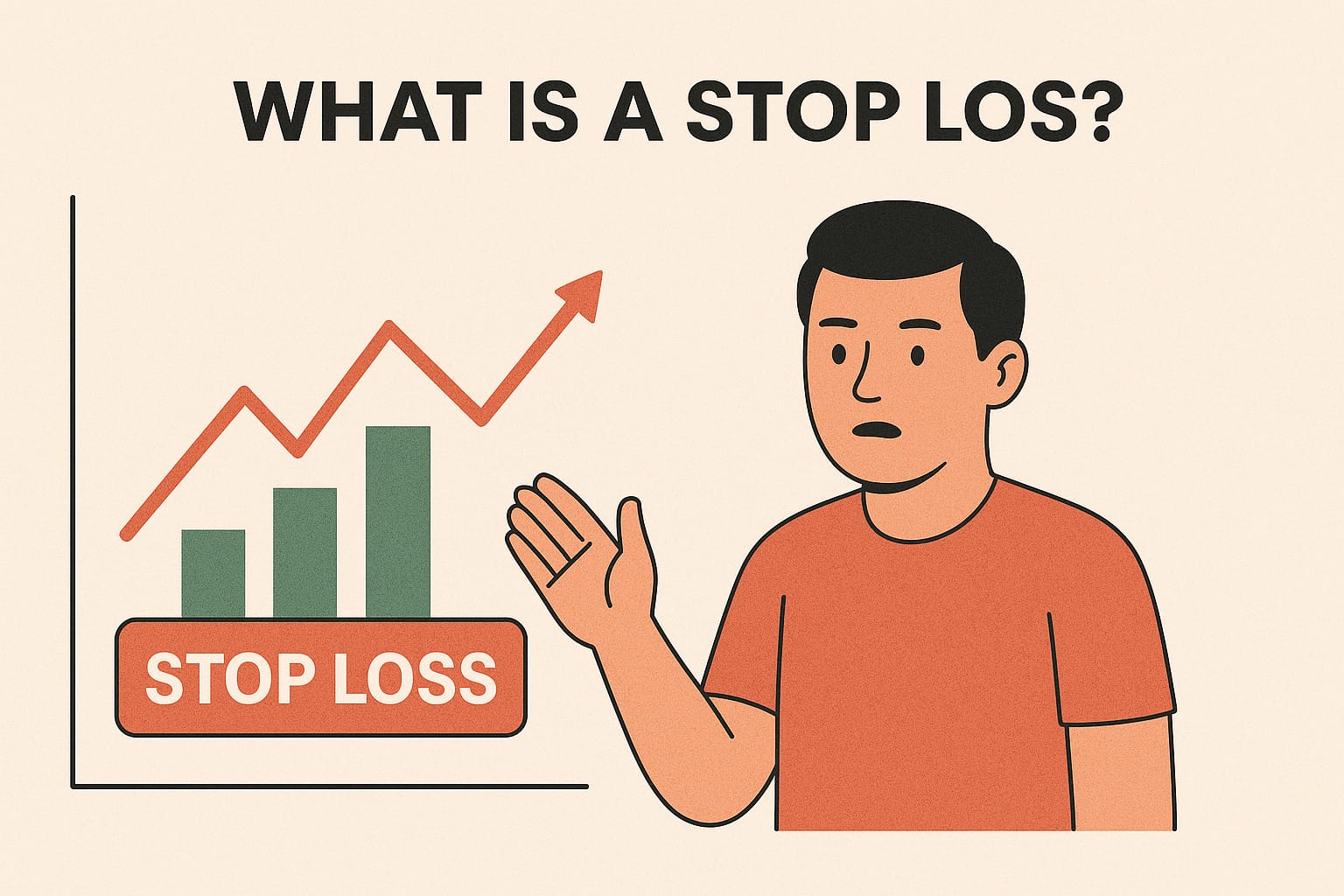
A stop loss is a predetermined level at which a trader exits a losing position to prevent further losses.
By setting a stop loss, investors can automatically sell or close a position when the price of an asset falls to a specific level.
This safety net limits the maximum loss a trader is willing to take on a particular trade.
Types of Stop Loss:
- Fixed Stop Loss: A static level below the purchase price.
- Trailing Stop Loss: A flexible stop that moves with the price to lock in profits as prices rise while capping losses if the market turns.

Psychological Cycle of a Losing Trade: Emotional Phases

-
Excitement at Buying
- Description: This phase begins with enthusiasm. Traders feel they’ve made a wise decision after researching the asset, convinced of its potential to generate profits.
- Psychological Insight: This initial excitement can create a “confirmation bias,” where traders focus only on information that supports their positive outlook, potentially overlooking risks.
-
Denial as the Trade Dips
- Description: As the asset’s price begins to drop, traders might ignore the reality of the situation, rationalizing the decline as a temporary fluctuation.
- Psychological Insight: This phase is marked by “cognitive dissonance,” where traders are mentally uncomfortable with the loss and may look for reasons to justify holding, convincing themselves it’s a minor setback.
-
Hope for Recovery
- Description: When losses deepen, traders often hold onto the position, hoping for a reversal. They might avoid setting a stop loss or stick to the belief that the market will turn around.
- Psychological Insight: This phase introduces “the gambler’s fallacy,” where traders believe that a reversal is “due.” Hope becomes a strong emotional driver, often clouding rational decision-making.
-
Fear as Losses Deepen
- Description: Fear sets in as losses accumulate, and traders start to panic. Despite the growing risk, they hesitate to sell, fearing the reality of realizing a loss.
- Psychological Insight: The “endowment effect” influences traders to overvalue their holdings simply because they own them. Fear of loss triggers indecision, making it harder to exit the trade.
-
Acceptance at Exiting with a Loss
- Description: Finally, traders reach a point of acceptance, acknowledging the need to exit to prevent further losses. Although difficult, this phase brings a sense of closure.
- Psychological Insight: Moving into acceptance often comes after significant financial and emotional strain. This experience can lead to self-reflection, prompting traders to reevaluate strategies and risk management for future trades.
Why Traders Hold Losing Trades
Despite the simplicity of a stop loss, traders often struggle to follow it due to psychological biases.
Here are a few reasons why traders hold onto losing trades:
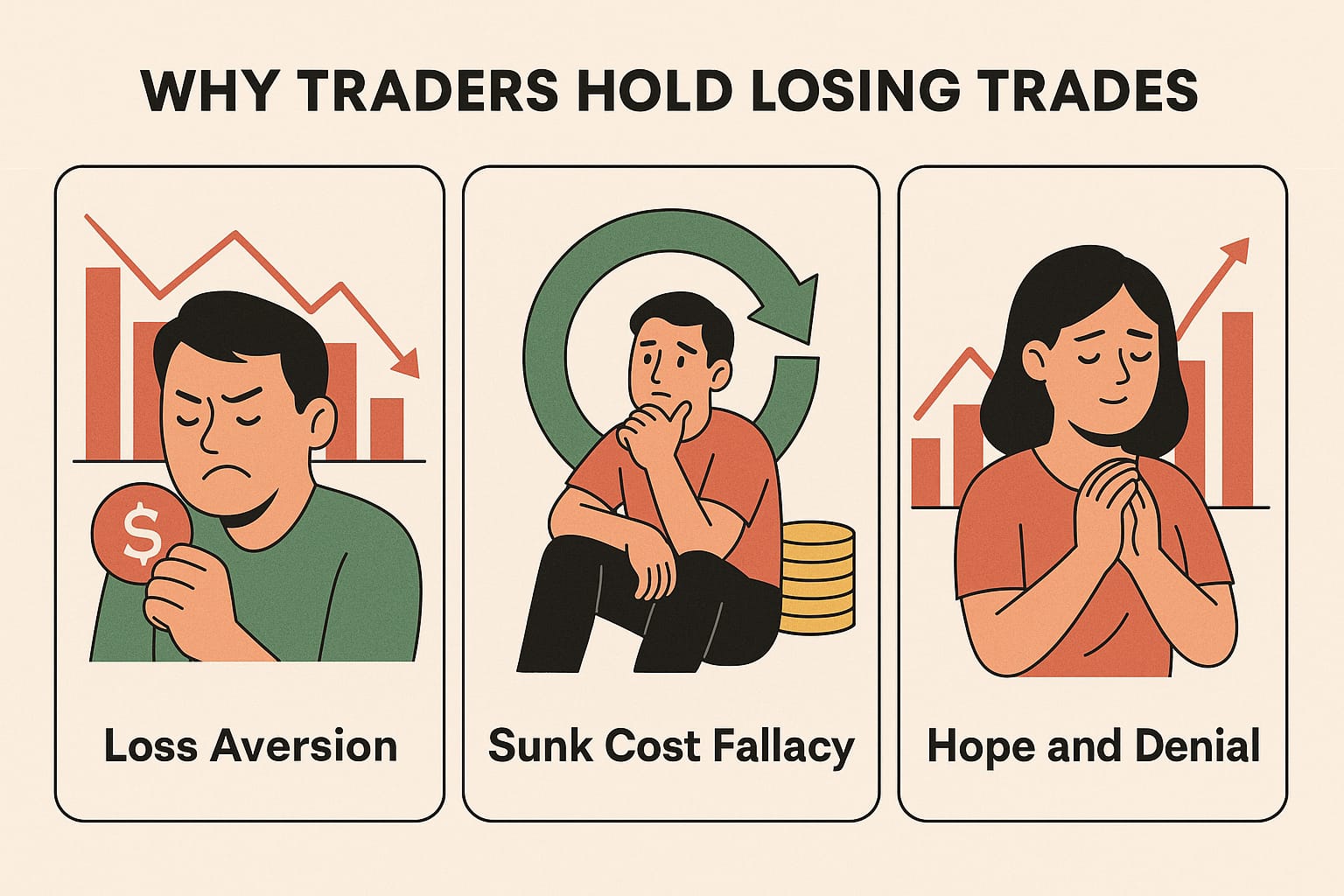
1. Loss Aversion :
Loss aversion, a term in behavioral psychology, means the pain of losing is psychologically more intense than the joy of winning.
This bias leads traders to avoid losses, even small ones, hoping for a turnaround.
Loss aversion is rooted in our instinct to avoid pain, which in trading manifests as hesitancy to exit a loss.
2. Sunk Cost Fallacy:
Traders often fall into the trap of holding on to a position because they’ve invested time or money into it.
This fallacy, common in many decision-making scenarios, leads to irrational choices because people feel they should “stick it out” to justify the resources already spent.
3. Hope and Denial:
Emotional attachment to a trade can lead traders to ignore reality, clinging to losses with hopes of recovery.
This phase often arises from denial, where traders convince themselves the market will reverse in their favor, even when clear indicators suggest otherwise.
Personal Story: The Cost of Ignoring Loss Aversion
When I first entered a trade in XYZ Company, I was excited.
I had spent hours researching the company, convinced that it was a solid investment with tremendous growth potential.
I felt confident, even proud, as I hit the “buy” button. Initially, everything looked great, and I felt validated in my decision.
However, within a week, the stock began to dip.
At first, it was just a small decline, and I shrugged it off as a “normal fluctuation” — a part of trading.
My original plan was to cut losses at 8%, a level I had carefully calculated to protect my capital.
But when the stock fell to that point, I hesitated.
I told myself it was just temporary volatility and that the stock would bounce back. “Just a little longer,” I thought, “and it’ll recover.”
As days turned into weeks, that small 8% loss grew to 15%, then 20%.
Every time I looked at my trading account, I felt a pang of regret mixed with hope.
I had invested so much time researching this stock; it just had to turn around.
I convinced myself that selling would mean admitting I was wrong.
Eventually, the loss swelled to a painful 30%, and it became clear that I had let my emotions dictate my actions.
The attachment I had to this trade — the time I spent analyzing and the expectations I set — clouded my judgment and cost me far more than I initially planned to lose.
This experience taught me that no amount of research can justify ignoring a stop-loss plan and that, in trading, emotional attachments are costly.
Recognizing Emotional Patterns through Effective Trading Journaling
Encouraging readers to keep a detailed trading journal will help them recognize emotional patterns that impact their decisions.
Here’s a guide to structuring a trading journal effectively:
- Basic Trade Information
- Entry and Exit Times: Record the exact times of entry and exit to identify if time of day affects your trading.
- Asset Traded: Include the stock, commodity, or other asset for clarity.
- Entry and Exit Prices: Document these accurately to analyze price performance.
- Stop Loss and Profit Targets
- Set Stop Loss and Target Levels: Note where you planned to place your stop loss and profit target. This helps you evaluate if your planning aligns with market movements.
- Adjustments Made: If you adjusted your stop loss or target mid-trade, document why and how you felt about it.
- Emotional Tracking
- Before the Trade: Capture initial emotions such as excitement, nervousness, or confidence. This may reveal if you tend to enter trades based on emotions rather than analysis.
- During the Trade: Note any shifts, like fear during a dip or hope in anticipation of a turnaround. Recognizing emotional patterns mid-trade can help with real-time decision-making.
- After the Trade: Reflect on your final emotions, like regret, satisfaction, or frustration. This will help you see if certain emotions impact your post-trade mindset or preparation for the next trade.
- Lessons Learned
- Personal Insights: Document any lessons you took away from the trade. For example, “I noticed that I ignored my stop loss rule due to hope, which led to a larger loss than planned.”
- Patterns Identified: Over time, your journal can reveal recurring behaviors, such as exiting trades too early due to fear or holding on due to hope.
Example Entry in a Trading Journal

Real-Life Example: Journaling as a Way to Spot Patterns

At the start of my trading journey, I often overlooked my emotions.
One day, I began keeping a journal, noting not only the reasons for each trade but also how I felt about each one.
Soon, I noticed a pattern: during market volatility, I’d hold onto losing trades much longer than intended.
Recognizing this through journaling helped me identify an emotional trigger and start developing a stronger exit strategy.
Why Booking Small Losses Early Is Crucial
When it comes to successful trading, it’s not just about making big wins; it’s also about protecting your capital by managing losses.
Accepting a small, manageable loss early on can keep you in the game longer, whereas holding onto a loss can lead to major setbacks.
Here’s a closer look at how small versus large losses impact your trading performance.

Scenario A: Accepting a 5% Loss with a Stop Loss
- Example: Imagine you buy shares of XYZ Corp at Rs. 100 and set a stop loss at Rs. 95. If the stock dips to Rs. 95, your position will automatically exit, limiting your loss to 5%. This manageable loss allows you to re-enter the market later, and you only need a 5.3% gain in future trades to recover.
- Recovery Needed: 5.3%
- Impact: This small loss can be quickly recovered with a minor gain in subsequent trades, preserving your capital for future opportunities.
Scenario B: Ignoring a Stop Loss, Resulting in a 50% Loss
- Example: Now imagine you bought the same stock at Rs. 100 but chose to ignore your stop loss as it dropped. The stock eventually falls to Rs. 50, leading to a 50% loss. To recover from this, you’d need a 100% gain (Rs. 50 to Rs. 100) just to break even—a challenging feat in any market.
- Recovery Needed: 100%
- Impact: A large loss not only drains capital but also requires much higher gains to recover, consuming more time and emotional energy. Holding onto big losses often has a psychological toll, making it harder to stay disciplined in future trades.
Experience of Scenario B: Ignoring a Stop Loss
One of my most painful lessons in trading came from a single decision: ignoring my stop loss.
I had invested in a stock with high hopes, and things seemed promising initially.
But not long after, the stock price began to fall, and I watched in disbelief as it inched closer to my predetermined stop-loss level.
I remember thinking, “It’s just a temporary dip — I’ll give it a bit more time.”
That was my first mistake.
As the stock kept dropping, I convinced myself that selling at a loss was worse than holding on.
I didn’t want to admit I was wrong; selling felt like failure. So, I ignored my stop loss.
Days passed, and the loss grew from 10% to 20%.
My emotions took over, and instead of cutting my losses, I kept hoping for a rebound.
I told myself stories about other stocks that had once dipped before they soared, hoping this would be the same.
But the turnaround never came.
Eventually, the stock dropped nearly 40%, and I was left grappling with both financial and emotional turmoil.
Every morning, I’d check the stock, feeling a mix of dread and regret, hoping for a miracle that never arrived.
It was a gut-wrenching experience. Recovering from that large loss drained both my capital and my emotional energy, and it took months to bounce back financially.
That experience taught me to respect my stop-loss rules because, in trading, protecting capital is always more valuable than stubbornly holding onto hope in a losing trade.
Strategies to Break the Cycle of Holding on to Losing Trades

Breaking the habit of holding onto losing trades requires a disciplined approach and practical strategies to address the psychological biases involved.
Here are actionable steps to help traders avoid emotional pitfalls and adhere to their stop-loss plans.
-
Establish Clear Entry and Exit Rules Before Each Trade
- Actionable Steps:
- Define Your Risk Tolerance: Determine the maximum percentage of loss you’re willing to take on a trade before entering it. This decision should be based on your overall risk tolerance and trading strategy.
- Set Both Stop Loss and Profit Target Levels: Decide not only on your stop-loss level but also on a profit target. Having both levels helps you manage expectations and avoid impulsive decisions during the trade.
- Write Down Your Rules: Document your entry and exit criteria, including reasons for setting these levels, in your trading journal. This reinforces accountability and reduces the chance of changing your plan mid-trade.
-
Reframe Losses as Learning Opportunities
- Actionable Steps:
- Review Trades Regularly: After closing each trade, analyze it for insights rather than focusing solely on the profit or loss. Ask yourself what went well, what didn’t, and what you can improve in the future.
- Focus on Process, Not Outcome: Shift your perspective from individual wins or losses to the quality of your decision-making process. This helps build a habit of valuing disciplined actions over short-term outcomes.
- Identify Patterns: Look for patterns in your behavior, especially in losing trades. For instance, if you notice that you tend to hold onto trades out of hope, make a note of this bias and remind yourself of it before each trade.
-
Practice Discipline with Small Trades
- Actionable Steps:
- Start with Minimal Position Sizes: If you’re new to using stop losses, begin with smaller trades. This approach allows you to build the discipline of exiting losing trades without risking a significant portion of your capital.
- Set Strict Stop Losses on Each Trade: Treat every small trade as if it were larger. This will train your mind to respect stop-loss levels, regardless of trade size.
- Gradually Increase Trade Size Only After Consistent Discipline: Once you feel comfortable and disciplined with smaller trades, increase your position sizes gradually. This approach helps you develop confidence in following your rules.
-
Implement a Pre-Trade Checklist
- Actionable Steps:
- Create a Checklist: Before entering any trade, go through a checklist to confirm you’ve set a stop loss, identified your target, and noted the reason for the trade.
- Include Emotional State Checks: Ask yourself if you’re feeling calm, anxious, or impulsive. Avoid trading if you’re experiencing strong emotions, as these can cloud judgment.
- Verify Market Conditions: Ensure you’re aware of market conditions that may affect your trade, such as high volatility periods or news events. Adjust your stop loss accordingly.
-
Use Alerts to Reinforce Stop-Loss Adherence
- Actionable Steps:
- Set Price Alerts Close to Your Stop Loss: Use alerts to remind yourself when a trade is approaching the stop-loss level. This can help you prepare emotionally to exit rather than making a sudden, stressful decision.
- Visualize Exiting the Trade: When the alert is triggered, mentally prepare to exit the trade. Visualizing yourself following through with the stop loss can reduce hesitation when the time comes.
- Reframe the Exit as a Positive Step: Remind yourself that exiting according to your plan is a win for discipline, even if it means taking a small loss. This perspective shift can reduce the emotional sting of closing a losing trade.
-
Establish a Cool-Down Period After Each Trade
- Actionable Steps:
- Take a Short Break After Each Trade: Avoid jumping into a new trade immediately after closing one. Taking a break can help you process the trade objectively and prevent revenge trading or emotional re-entry.
- Reflect on the Trade’s Outcome and Process: Use this time to jot down your reflections in your trading journal. If the trade resulted in a loss, note whether you followed your rules and what you learned from the experience.
- Reset Your Mindset: If you’ve experienced a loss, remind yourself that one trade doesn’t define your trading journey. This reset helps keep you focused and emotionally neutral for your next opportunity.
-
Simulate Stop-Loss Scenarios to Build Confidence
- Actionable Steps:
- Use Paper Trading or Simulations: Practice placing stop losses in simulated trades. Treat these practice trades as if they’re real, paying attention to your emotions and how you react to losses.
- Run “What-If” Scenarios: Think through different scenarios, such as “What if the stock hits my stop loss?” or “What if the trade goes in my favor?” This can mentally prepare you for a range of outcomes, reducing emotional reactivity.
- Analyze Your Reactions: After each simulation, assess your emotional responses. Note if you’re more comfortable following the stop loss or if you still feel the urge to hold on. This can help identify areas for emotional improvement before risking real capital.
-
Set a Reward System for Following Your Rules
- Actionable Steps:
- Create a Rewards Chart: Every time you follow your stop-loss rule, mark it on a rewards chart. After a set number of disciplined exits, reward yourself with something meaningful, like a favorite treat or a small gift.
- Acknowledge Small Wins: Reinforce the positive behavior by acknowledging small wins, even if they involve taking a loss. This process can make following stop losses feel rewarding, building confidence over time.
- Reflect on Progress Monthly: Each month, review your chart to track your progress. This can motivate you to keep following your rules and celebrate how much you’ve improved.
Personal Success Story: Building Discipline with Small Trades

When I first started trading, I was filled with enthusiasm and big dreams, eager to make quick profits.
But I also knew that the market could be unforgiving, especially for beginners like me.
So, instead of diving in with large trades, I decided to start small.
My initial goal wasn’t to make big profits but to develop the discipline to stick to my trading plan—especially my stop-loss strategy.
My first few trades were small, each with a strict stop-loss level in place.
I treated each trade seriously, setting both a stop-loss and a profit target.
With smaller amounts on the line, I felt more relaxed, which allowed me to follow my plan without the pressure of risking significant capital.
In one of my earliest trades, the price moved against me, and my stop-loss level was hit.
I remember the hesitation as I watched the price approach my stop, thinking, “Maybe it’ll turn around if I give it a little more time.”
But I reminded myself that the whole purpose of starting with these small trades was to practice discipline, so I let the stop-loss execute and took the small loss.
That trade didn’t break the bank, but it taught me a valuable lesson: sticking to the plan feels empowering, even if it means accepting a minor loss.
Over the next few months, I continued trading small positions, each time refining my ability to detach emotionally from the outcome and focus on my process.
Every time I followed my stop-loss rule, I marked it in my trading journal, celebrating the fact that I was building discipline—a trait that’s far more valuable than any short-term profit.
Gradually, as my confidence grew, I increased my trade sizes.
By that time, following my stop-loss rule had become second nature.
I had learned to view each exit as a sign of success, knowing I was protecting my capital and avoiding larger losses.
Looking back, I realize that starting small was one of the best decisions I made.
It gave me the freedom to make mistakes, learn from them, and develop the discipline that now guides me in every trade.
Building discipline with those small trades wasn’t just a phase; it became the foundation of my trading career.
Common Mistakes Traders Make with Stop Loss
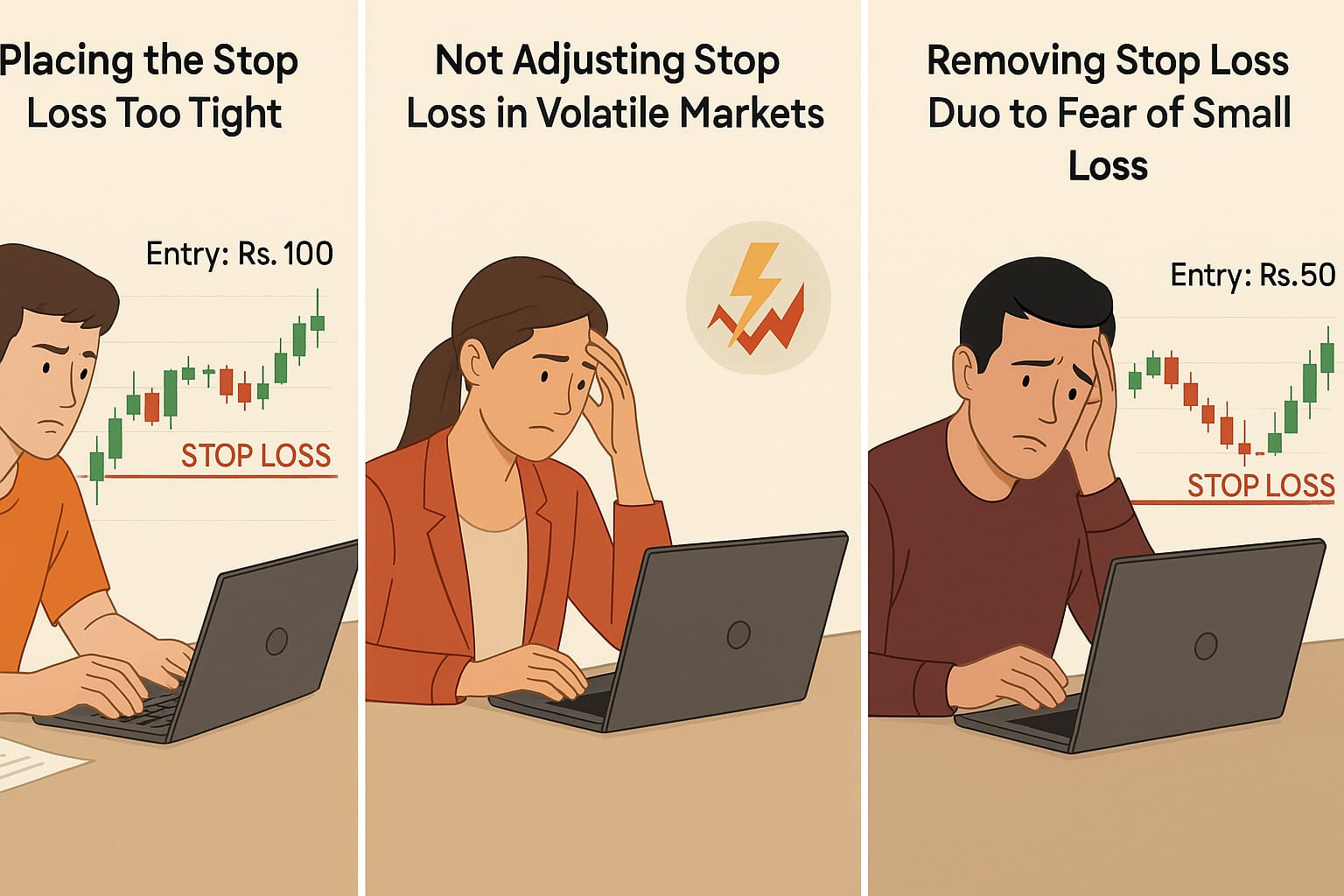
- Placing the Stop Loss Too Tight
- Description: Setting a stop loss too close to the entry price can result in premature exits due to normal market fluctuations.
- Case Study: Ravi bought shares of ABC Corp at Rs. 100 and set a stop loss at Rs. 98, just 2% below the entry.
- Unfortunately, the stock briefly dipped to Rs. 97.50 due to market volatility, hitting his stop loss before rebounding to Rs. 110. Ravi realized that his stop loss was too tight, causing him to miss out on a potential profit.
- Not Adjusting Stop Loss in Volatile Markets
- Description: Markets can experience sudden surges or drops, and failing to adjust the stop loss in these situations can lead to unintended exits or larger-than-expected losses.
- Case Study: Priya was trading XYZ Futures during an earnings report.
- She set her stop loss 5% below her entry point, but the increased volatility caused an unexpected price drop.
- Without adjusting her stop loss, she was forced out of the trade during a temporary dip, only to watch the asset recover afterward.
- This experience taught her the importance of recalibrating stop losses in volatile periods.
- Removing the Stop Loss Due to Fear of a Small Loss
- Description: Some traders remove their stop losses because they fear taking a minor loss, hoping the asset will recover. This often leads to even bigger losses.
- Case Study: Amit purchased DEF Ltd. at Rs. 500, setting a stop loss at Rs. 475.
- When the price dropped to Rs. 480, he felt uncomfortable with the idea of taking a loss, so he removed the stop loss.
- The stock continued to fall, eventually reaching Rs. 400. Amit learned that sticking to his original stop loss plan would have limited his losses significantly.
Real-Life Examples of Not Using Stop Loss
1. Yes Bank (2018-2020):
This once-high-performing stock dropped nearly 95% from ₹400 to below ₹20.
Traders who didn’t use stop losses were left with minimal value in their investments.
2. Reliance Infrastructure (F&O):
From ₹450 to below ₹50, the sharp decline in Reliance Infrastructure’s stock left F&O traders with substantial losses if they didn’t have stop losses in place, exacerbated by leverage.
Personal Reflection on Yes Bank
The story of Yes Bank serves as a haunting reminder of what can happen when traders hold onto hope in a losing trade.
I vividly recall watching the stock price plummet, and every day, I would see traders online and in forums clinging to the hope of a turnaround.
These were people who, like me, believed in the potential of the stock.
They talked about the bank’s past successes, its strong client base, and how “things would get better.”
But as days turned into weeks, the stock kept falling.
I knew several traders who had invested significant portions of their savings in Yes Bank, convinced that it would recover.
They had overlooked the signs, disregarded market warnings, and ignored any thoughts of a stop loss because they couldn’t bear the thought of realizing a loss.
Holding onto hope, they watched helplessly as their investment lost nearly 95% of its value.
Seeing this play out in real time had a profound impact on me.
I realized that discipline in trading is not just about setting rules; it’s about having the strength to follow them, even when every instinct says otherwise.
Observing the emotional toll this took on those traders — the regret, the anxiety, the constant checking of prices — reinforced the need for strict risk management.
Since then, I’ve approached my trades with a stronger commitment to stop losses, knowing that hope is no substitute for a disciplined plan.
Stop Loss in Different Types of Markets

Each market type demands a tailored stop loss approach:
- Equity Markets: Use fixed or trailing stops based on the volatility of individual stocks.
- Futures & Options (F&O): Tight stops are crucial due to leverage, and hedging with options can further limit risk.
- Commodities: Volatility-based stops help manage large price swings typical in commodities like gold or oil.
- Currency (Forex) Markets: Pip-based and time-based stops work well due to the daily volatility of forex pairs.
- Index Trading: Dynamic or percentage-based stops are effective for managing risk in broader market movements.
How Stop Loss Enhances Discipline
Stop losses go beyond risk management—they are instrumental in fostering discipline by setting non-negotiable exit points that help traders avoid emotionally-driven decisions.
In volatile markets, a predefined stop loss reduces the tendency to second-guess or hold onto losses fueled by hope or fear.
Adhering to a stop-loss plan not only minimizes losses but also preserves capital, enabling traders to focus on the next opportunity rather than fixating on past setbacks.
Over time, this commitment to discipline builds confidence, allowing traders to face the market with resilience and consistency, regardless of market conditions.
Key Takeaways
- The Role of Stop Loss: A stop loss isn’t just a number; it’s a psychological and financial anchor, designed to keep losses manageable. Stick to it to avoid emotional decisions.
- Psychological Traps: Common biases, such as loss aversion and the sunk cost fallacy, make it hard to accept losses. Recognizing these biases can help you break the cycle of holding onto losing trades.
- Adapt Strategy to Market Type:
- Equities: Use trailing or fixed stops based on individual stock volatility.
- Futures & Options: Prioritize tighter stops and consider hedging for leveraged positions.
- Commodities: Volatility-based stops accommodate commodity swings.
- Forex: Pip-based stops offer control within daily volatility.
- Indices: Percentage-based stops work well for broader market moves.
- Discipline and Journaling: Regular journaling helps you track emotions and identify patterns, reinforcing disciplined trading habits.
- Early Loss Acceptance: Booking small losses early preserves capital and enables long-term success by preventing emotionally driven decisions.
Conclusion
The importance of stop loss cannot be overstated.
It is a critical tool for risk management, ensuring that small losses don’t spiral into catastrophic financial damage.
Stop losses foster discipline, minimize emotional trading, and protect capital, enabling traders to stay resilient in the markets.
In trading, sometimes the best move is to “lose a battle to win the war.
” Embracing the stop loss strategy allows traders to approach the market with confidence, knowing their risk is managed and potential losses are limited.
Remember: Every trade is an opportunity to strengthen your discipline and protect your capital.
The key to lasting success in trading isn’t just in the big wins—it’s in managing small losses wisely and sticking to your plan.
Make this commitment now.